Environment, Natural
Resources, and Society
Forest Ecology and Management/Rural Sociology/Sociology 248
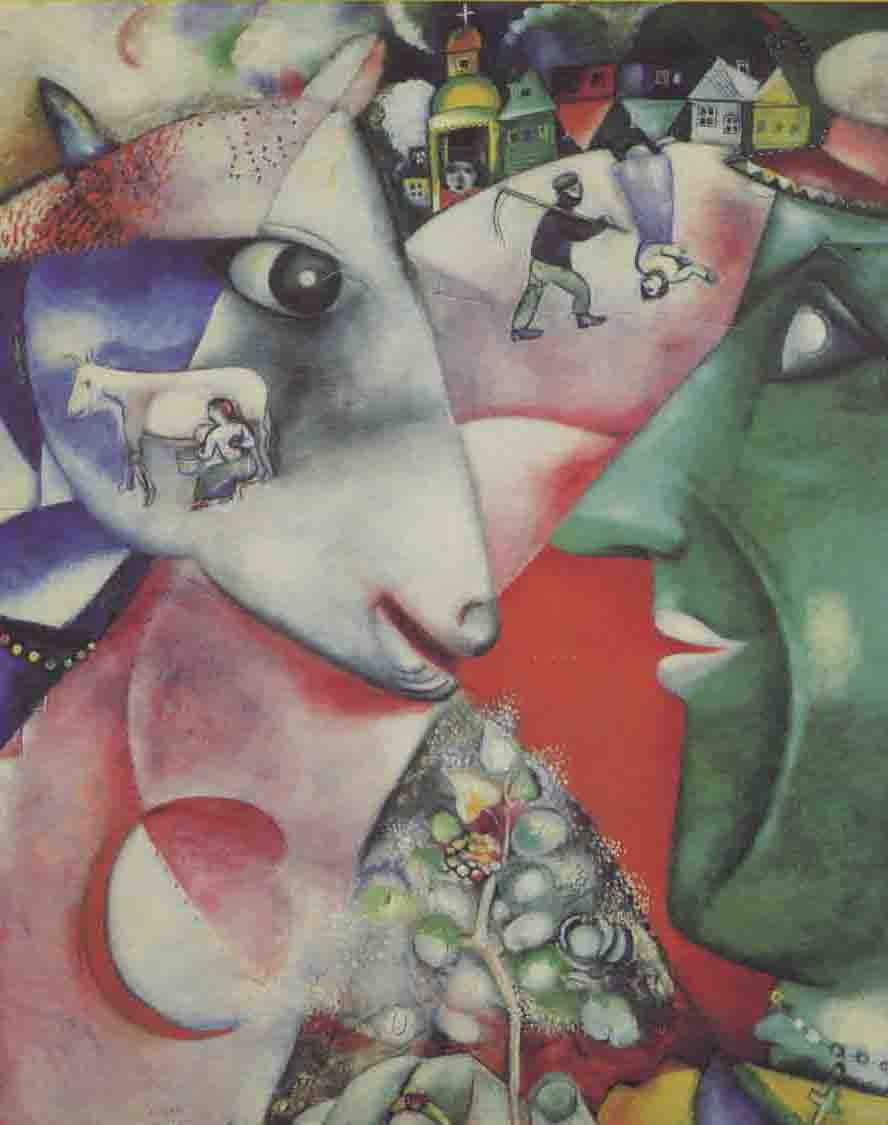
I and the Village--Marc Chagall, 1911
Instructor: Michael M. Bell
340D Agricultural Hall
michaelbell@wisc.edu
Fall, 2004
University of Wisconsin-Madison
M/W 4:30-5:20, 125 Ag Hall
Download the 2004 syllabus here.
The topic of this course, it could be said, is the study of community in the largest possible sense. Land, water, air, people, and other animals--all of these are closely interconnected. Together, they form a kind of solidarity, what we have come to call “ecology” and the “environment.” And like any real community—any real interconnected solidarity—there is also much conflict here. This course studies this largest of communities from a sociological perspective, with an eye to understanding the origins of, and solutions to, these all-too-real social and biophysical conflicts.
The course falls into four parts:The Moral: the mess we're in and why we should care about it;
The Material: the roles played by material desire, the profit motive, technology, population, the body, and biophysical resources;
The Ideal: the influence of culture, ideology, and social experience on how we think about the environment;
The Practical: solutions to environmental conflicts that take all three of the above into account.In short, this is a class on the sociology of how to save the world!
Getting Ahold of the Books and Readings
All of the books for the course are available at the Rainbow Cooperative, 426 West Gilman Street, and the course pack of the other readings is available at Bob’s Copy Shop, 37 University Square. As well, all of the readings and books are on material (but not electronic) reserve at Steenbock Library, plus a few that are available for free on the web (as linked below).
Books
Everyone should acquire the main text; choose one book from each "book club."Main Text
Bell, Michael M., with Michael S. Carolan. 2004 (1998). An Invitation to Environmental Sociology. Second edition. Newbury Park, CA: Pine Forge Press (Sage).
Book Club I
Klein, Naomi. 2000. No Logo: Taking Aim at the Brand Bullies. Picador.
Korten, David. 2001. When Corporations Rule the World. 2nd edition. West Hartford, CT: Kumarian Press.
Lasn, Kalle. 1999. Culture Jam: The Uncooling of America. New York: Eagle Brook.
Schor, Juliet. 2000. Do Americans Shop Too Much? Joshua Cohen and Joel Rogers, eds. Boston: Beacon Press.Book Club II
Heinberg, Richard. 2003. The Party's Over: Oil, War, and The Fate of Industrial Societies. Gabriola Island, British Columbia: New Society.
Meadows, Donella, Jorgen Randers, and Dennis Meadows. 2004. The Limits to Growth: The 30-Year Update. Williston, VT: Chelsea Green.
Schlosser, Eric. 2002. Fast Food Nation: The Dark Side of the All-American Meal. New York: Perennial.
Steingraber, Sandra. 2001. Having Faith: An Ecologist’s Journey to Motherhood. New York: Berkley Books.Book Club III
Bradsher, Keith. 2004. High and Mighty: The Dangerous Rise of the SUV. Public Affairs.
Deming, Alison and Lauret E. Savoy. 2002. The Colors of Nature: Culture, Identity, and the Natural World. Minneapolis, MN: Milkweed Editions.
Erikson, Kai. T. 1994. A New Species of Trouble: Explorations in Disaster, Trauma, and Community. New York: Norton.
Klinenberg, Eric. 2002. Heat Wave: A Social Autopsy of Disaster in Chicago. Chicago: University of Chicago Press.Book Club IV
AtKisson, Alan. 1999. Believing Casandra: An Optimist Looks at a Pessimist’s World. Williston, VT: Chelsea Green.
Brown, Lester. 2001. Eco-Economy: Building an Economy for the Earth. New York: Norton.
Suzuki, David and Holly Dressel. 2002. Good News for a Change: Hope for a Troubled Planet. Vancouver: Greystone Books.
Weisman, Alan. 1999. Gaviotas: A Village to Reinvent the World. Williston, VT: Chelsea Green.
Course Schedule
Week One
9/8. IntroductionNo reading.
The Moral
Week Two
9/13. The Mess We’re All In and Why We Should Care About It
9/15. Ecological DialogueBell, chapter 1, “Environmental Problems and Society.”
Leopold, Aldo. 1961 (1949). "The Land Ethic," in A Sand County Almanac. San Francisco: Sierra Club Books. Pp. 237-264.
Week Three
9/20. Ecological Dialogue, Continued
The Material
9/22. Those Consumin' Humans
Bell, chapter 2, “Consumption and Materialism.”
Maslow, Abraham. 1970 (1954). “A Theory of Human Motivation.” in Motivation and Personality, 2nd edition. New York: Harper and Row. Pp. 80-106.
Sahlins, Marshall. 1972. “The Original Affluent Society,” in Stone Age Economics. New York: Aldine. Pp. 1-39.Week Four
9/27. The Treadmill of Consumption9/29. From Consumption to Production: From One Treadmill to Another
Bell, chapter 3, “Money and Machines.”
Book Club I
Week Five
10/4. Markets, Technologies, the Environment, and Freedom
10/6. Technology and the Social Organization of ConvenienceBell, chapter 4, “Population and Development.”
Hardin, Garrett. 1992. “The Ethics of Population Growth and Immigration Control.” Pp. 6-7 in Crowding Out the Future: World Population Growth, US Immigration, and Pressures on Natural Resources, Robert W. Fox and Ira H. Melham, eds. Washington, DC: Federation for American Immigration Reform.
Lappé, Frances Moore, Joseph Collins, and Peter Rosset. 1998. 12 Myths About Hunger. Institute for Food and Development Policy Backgrounder, Summer 1998, Vol.5, No. 3. Retrieved August 26. 2004, from http://www.foodfirst.org/pubs/backgrdrs/1998/s98v5n3.html. 5pp.
Malthus, Robert Thomas. 1976 (1798). “Preface” and “Chapter 1.” Pp. 15-21 in An Essay on the Principle of Population. Philip Appleman, ed. New York: Norton.
McKibben, Bill. 1998. “The case for single-child families.” The Christian Century. 115 (15) May 13, pp. 498-504.
McKibben, Bill. 1998. “Immigrants aren't the problem. We are.” New York Times. March 9, p. A19.
Nierenberg, Danielle and Mia MacDonald. 2004. “The Population Story…So Far.” Worldwatch Magazine 17(5):14-17.
Pimentel, David and Anne Wilson. 2004. “World Population, Agriculture, and Malnutrition.” Worldwatch Magazine 17(5):22-25.
Simon, Julian L. 1980. “Resources, Population, Environment: An Oversupply of False Bad News.” Science 208 (#4451, June 27): 1431 37.Week Six
10/11. The Great Population and Development Debate, I
10/13. The Great Population and Development Debate, IIBell, chapter 5, “Body and Health.”
Book Club II
10/15-10/18. 72-hour take-home midterm exam. Exam due in lecture, at 4:30pm.
The exam as a Word document
The exam as a PDF
Nota bene: we are currently running a week behind on the lectures, and thus the lectures below will likely change
dates accordingly, as we need to cover issues of body and health before we get to the below. There may also be some
reorganization of the readings to fit.The Ideal
Week Seven
10/18. Environment, Domination, and Culture
10/20. The Ecofeminism Debate
Bell, chapter 6, “The Ideology of Environmental Domination.”
White, Lynn. 1967. “The Historical Roots of Our Ecological Crises.” Science 155:1203-1207.
Debate group selection
Week Eight
10/25. The Rise of Concern for the Environment
10/27. Theories of the Rise of ConcernBell, chapter 7, “The Ideology of Environmental Concern.”
Dunlap, Riley E. 2002. “An Enduring Concern: Light Stays Green for Environmental Protection.” Public Perspective Sept/Oct, pp. 10–14.
Lao-Tzu. Circa 500 B.C.E. Tao Te Ching. Available here.
Debate group selection
Week Nine
11/1. What is Nature, Anyway
11/3. What is Wilderness, Anyway?
Bell, chapter 8, “The Human Nature of Nature,” pp. 207-241.
Book Club III

Week Ten
11/8. Risk and Culture
11/10. Risk and DisasterBell, chapter 9, “The Rationality of Risk”
Erikson, Kai T. 1994. “Three-Mile Island: A New Species of Trouble.” Pp. 139-157 in A New Species of Trouble: Explorations in Disaster, Trauma, and Community. New York: Norton.Week Eleven
11/15. Risk and Democracy
11/17. Are Environmental Problems Real?Lomborg, Bjorn. 2001. “Things Are Getting Better,” pp. 3-33 and 353-359 in The Skeptical Environmentalist: Measuring the Real State of the World. Cambridge University Press. Available here.
Rennie, John, ed. 2002. “Misleading Math About the Earth: Science Defends Itself Against The Skeptical Environmentalist.” Scientific American. Available here.
Various authors. 2001. “Something is Rotten in the State of Denmark: A Skeptical Look at The Skeptical Environmentalist.” Grist Magazine. Available here.
The Practical
Week Twelve
11/22. The Dialogue of Environmental Change
11/24. Special Event to Be AnnouncedBell, chapter 10, “Organizing the Ecological Society.”
First draft of group paper due, 11/24.Thanksgiving Vacation
Week Thirteen
11/29. Divided We Fall: Community, Environment, and Collective Action
12/1. An Unfinalizable Aliveness
Book Club IV
Weeks Fourteen and Fifteen
Debating the Ecological Society
12/7: 4:30, Debate I; 5:30 Debate II
12/8: 4:30, Debate III; 5:30, Debate IV
12/9: 4:30, Debate V
12/13: 4:30, Debate VI; 5:30 Course Review
12/14: 4:30, Debate VII; 5:30, Debate VIII
12/15: 4:30, Debate IXEach student is expected to attend the course review and 5 of the 9 debates.
Final draft of group paper due, 12/13.
12/14-12/17. 72-hour take-home final exam. Exam due Friday, December 17th, by 9:25pm.
All material at this site © 2004 Michael Mayerfeld Bell
Last updated October 13, 2004